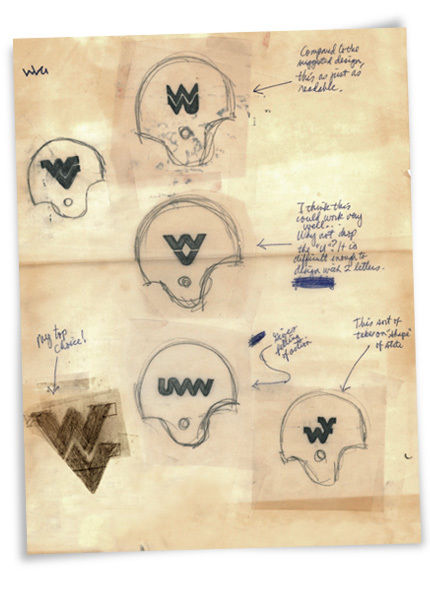
The Legend of The Flying WV
Written by Jake Stump
Illustrations by Chris Schwer
Former football coach Don Nehlen’s son scrawled it on construction paper with crayon?
No, that’s not right.
Well, then, it actually originated when one of the ball boys saw clouds in the sky forming a W and V together during a scrimmage?
Wait. That’s not it, either.
How many tall tales and legends have you heard about the origins of the Flying WV, one of the most recognized university and sports logos in the world?
What’s the true story?
Everyone involved—from the coach, an artist, an equipment manager, and a sports information director—has a different variation of the story.
But don’t worry. Through hardnosed, investigative (ahem) journalism, the real story will be pieced together right here.
The truth shall set you free, like a Mountaineer.
John Martin designed West Virginia University’s logo, the Flying WV, in 1980. It has become one of the most recognizable college logos in the world.
SOMETIMES IT TAKES BAD TO MAKE GOOD
Look no further than the late-1970s if you’re seeking a forgettable era of Mountaineer football.
After wrapping up five years with a winning record as Mountaineer head coach, Bobby Bowden left the helm in 1975 for a warmer climate at Florida State. There, he’d go on to establish a legendary 34-year career leading the Seminoles to two national championships.
With Bowden gone, so were the WVU victories. Following Bowden’s departure, the Mountaineers slogged through four consecutive losing seasons (1976-79).
“I wanted a distinct helmet. I wanted everybody to know that when West Virginia University hit the field, they’d know who we were.”
The Mountaineers could not even lose with style, so to speak, in those darkened days.
The distinct gold-and-blue color scheme and Flying WV logo we’ve come to adore did not exist at that point. Instead, football players bore a bronzesque gold helmet emblazoned with a blue outline of the state of West Virginia and the letters “WVU” inside an oval.
Blah.
The gold of the helmet did not reflect the gold utilized in our colors today. Think of a darker, Notre Dame-like gold, only uglier. The helmets also came in a white version.
By 1980, it was time for an extreme makeover: Mountaineer edition.
Leading this new revolution would be Don Nehlen, a former Bowling Green quarterback who later coached at his alma mater and served a two year stint as quarterbacks coach at the University of Michigan.
He was now charged with rebuilding the WVU football program.
When he arrived in Morgantown in December 1979, he dove headfirst into the game film.
But there was one glaring problem. He couldn’t tell which team was WVU.
“I had trouble figuring out which team West Virginia was,” Nehlen said. “The uniform was white. The helmet was white, and had the state of West Virginia on it. You really couldn’t tell that unless you held one in your hand.
“I thought the colors were supposed to be blue and gold. I wanted a distinct helmet. I wanted everybody to know that when West Virginia University hit the field, they’d know who we were.”
Nehlen shared his vision with the equipment manager, Mike Kerin. The coach was seeing dark blue and gold. After all, Nehlen had just come from Michigan, whose colors and logos bear a slight resemblance to WVU’s.
He told Kerin, “I want a dark, blue helmet, and I want a WV on both sides.”
THE CONFUSION
At this stage of the game, the story gets murky.
Nehlen claims he and Kerin sat down and drew designs for the new logo.
But no one else—Kerin included—recalls that ever happening. Kerin asserts that he and Nehlen never drew any sketches.
They were no van Gogh and Monet.